
.png)
Why Most Enterprise AI Projects Stall at the POC Stage


.png)
Introduction
A working prototype isn't the same thing as a working product, yet plenty of enterprise teams treat the two as interchangeable. Industry surveys on AI adoption have pointed to a wide gap between the number of pilots companies launch and the number that ever reach a production environment, and that gap isn't shrinking as fast as budgets are growing. The pattern shows up across industries, team sizes, and technology stacks, which suggests the root cause has less to do with the models themselves and more to do with how the projects are run.
This is the uncomfortable part for a lot of technology leaders: the model usually works. What breaks down is everything around it — ownership, infrastructure, security review, and the handoff between "we proved it's possible" and "we're running this every day." Understanding why most enterprise AI projects stall at the POC stage requires looking past the algorithm and into the delivery process that surrounds it. This article walks through the specific failure points, the cost of letting a pilot sit in limbo, and how a sprint-based delivery model closes the gap between a proof of concept and a live system.
The POC Trap: Why "It Worked in Testing" Isn't Enough
Teams often measure a proof of concept against a narrow question: can the model produce the right output under controlled conditions? That's a legitimate first test, but it's a different question from whether the system can hold up against real users, real data volume, and real edge cases. Confusing the two is one of the clearest reasons why most enterprise AI projects stall at the POC stage, because the criteria that got a project approved aren't the criteria it needs to meet to stay funded.
A written paragraph between the header and the next section matters here because the disconnect isn't obvious until a team tries to move forward. Everyone nods along during the demo, funding gets discussed, and then the project quietly loses momentum once someone asks what it will take to put the system in front of actual customers or employees.
POC Success Criteria vs. Production Success Criteria Are Different Problems
A proof of concept is typically judged on accuracy against a curated dataset, response quality on a handful of test cases, and whether the concept is technically feasible at all. Production asks a longer list of questions: What happens under peak load? What happens when the input data is messy or incomplete? Who is accountable when the system makes a mistake? None of these questions get answered by a successful demo, and teams that don't plan for them early tend to discover the gap only after leadership has already signed off on the concept.
Why a Working Demo Creates False Confidence With Stakeholders
A polished demo is persuasive, and that's exactly the problem. Once a room full of decision-makers watches a model return the right answer a few times in a row, the assumption becomes that the hard part is finished. In reality, the demo represents a small fraction of the total engineering work a production system requires. Stakeholders walk away expecting speed; engineering teams walk away needing months for integration, data pipelines, and compliance sign-off. That mismatch in expectations is often what quietly kills momentum before a formal decision to stop the project ever gets made.
The Real Reasons Enterprise AI Pilots Never Scale
Beyond the mismatch in success criteria, there are a handful of operational reasons pilots stall out, and most of them repeat across organizations regardless of industry. Recognizing these patterns early gives a team the chance to address them before they become blockers.
No Clear Owner or Budget for the "Next Phase"
Many pilots get approved as innovation projects, funded out of a discretionary budget, without a clear owner once the proof-of-concept phase wraps up. When nobody on the business side is explicitly responsible for driving the system toward production, it sits in a queue behind projects that do have dedicated ownership and budget lines.
Data Infrastructure Wasn't Built for Production Load
A pilot frequently runs on a clean, static dataset prepared specifically for testing. Production requires live data pipelines, ongoing data quality checks, and infrastructure that can handle volume the original test never simulated. Teams that didn't plan the data architecture with scale in mind end up rebuilding large portions of the system rather than simply expanding it.
Integration With Legacy Systems Was Never Scoped
Enterprise environments are rarely greenfield. A pilot built in isolation, without connecting to the CRM, ERP, or ticketing systems it will eventually need to talk to, hits a wall the moment someone tries to wire it into daily operations. Integration work is often the single largest source of delay because it wasn't part of the original scope.
Security and Compliance Review Starts Too Late
Security and legal teams are frequently brought in only after a pilot has already proven the concept, which means any concerns they raise land as late-stage surprises rather than early design constraints. Reworking a system to satisfy a compliance requirement after the architecture is already set is far more expensive than designing around it from the outset.
The Build Was Scoped Around a Demo, Not a Workflow
A pilot designed to impress a room is not the same thing as a pilot designed to fit into how people actually work. When the build targets a specific demo scenario rather than the full range of real-world use cases, the system looks impressive on stage and falls short the moment someone tries to use it for an actual task.
Stakeholder Alignment Breaks Down After the Initial Pitch
The excitement that gets a pilot approved doesn't always survive contact with budget cycles, competing priorities, and staff turnover. Sponsors move to other projects, priorities shift at the executive level, and the pilot loses the internal champion it needed to keep moving.
The Hidden Cost of Stalled Pilots
A pilot that stalls doesn't just waste the resources already spent on it — it creates costs that compound the longer it sits unresolved.
Sunk Engineering Time and Eroded Internal Trust in AI Initiatives
Engineering hours spent on a pilot that never ships are hours that could have gone toward a project with a clearer path forward. Beyond the direct cost, repeated stalled projects make it harder to get buy-in for the next AI initiative. Teams start to view "AI project" as shorthand for "thing that consumes budget and produces a demo video," which makes future proposals a harder sell regardless of merit.
Competitive Slippage While Pilots Sit in Limbo
While an organization debates the next phase of a stalled pilot, competitors that moved faster are already capturing the operational advantage the technology was meant to deliver. In fast-moving categories, the cost of delay isn't just internal frustration — it's a market position that becomes harder to reclaim the longer it takes to act.
What a Sprint-Based Delivery Model Changes
A sprint-based delivery process addresses these failure points directly by treating production readiness as the goal from day one, rather than a phase that begins after approval.
Scoping for Production From Day One, Not After POC Approval
Instead of building a narrow demo and hoping the rest falls into place, a sprint-based approach scopes data requirements, integration points, and security needs at the very start. This doesn't slow the pilot down — it prevents the far more expensive rework that happens when those requirements surface late.
Compressed Timelines That Force Early Architecture Decisions
Short, fixed sprints create pressure to make real architectural decisions early rather than deferring them. Teams can't hide behind a loosely defined scope when the next checkpoint is only a week or two away, which keeps the project honest about what it will actually take to reach production.
Parallel Workstreams Instead of Sequential Handoffs
Rather than finishing the model, then starting integration, then starting security review, a sprint-based model runs these workstreams in parallel. Data engineering, integration planning, and compliance review happen alongside model development, which cuts significant time off the overall path to launch.
Built-In Checkpoints Tied to Deployment Milestones, Not Demo Dates
Checkpoints in a sprint-based process are tied to what it takes to deploy — infrastructure readiness, integration testing, security sign-off — rather than to the date of the next stakeholder demo. That keeps the team's attention on what actually needs to happen to go live, not on what will look impressive in a meeting.
What This Looks Like in Practice
Turning this into a concrete process usually follows four stages: Discovery and Scoping, Solution Architecture, Build and Validate, and Deploy and Scale. Discovery identifies the real workflow the system needs to support, along with the data and integration requirements that come with it. Solution Architecture locks in the technical approach before a single production line of code gets written. Build and Validate develops the system in short cycles with continuous testing against production-like conditions. Deploy and Scale handles the rollout, monitoring, and the operational handoff that keeps the system running after launch.
How This Shortens Time-to-Value Without Cutting Corners on Governance
Compressing the timeline doesn't mean skipping steps — it means running steps that used to happen sequentially at the same time, with clear ownership at each stage. Security and compliance are part of the architecture conversation from week one, not a gate that appears after the build is finished. That structure is what lets a team move fast without discovering, three months in, that the whole approach needs to be reworked.
Enterprise AI doesn't stall because the technology isn't ready — it stalls because the delivery process wasn't built to carry it past the demo stage. A sprint-based model that scopes for production from the start, runs workstreams in parallel, and ties checkpoints to deployment rather than presentation dates is what separates a pilot that ships from one that quietly disappears. Techtics runs enterprise AI delivery this way, with a four-week framework built to move systems from discovery to deployment instead of leaving them stuck at the demo. If a pilot on your roadmap needs a clearer path to production, it's worth talking through what that path actually looks like — because a proof of concept only proves its worth once it stops proving and starts producing.
FAQ's
Why do most AI POCs fail to reach production?
Most stall because the project was scoped and measured as a demo rather than as a production system. Ownership, data infrastructure, integration, and security requirements get addressed too late to keep the momentum going.
What's the difference between an AI pilot and an AI MVP?
A pilot is typically built to prove a concept is technically feasible under controlled conditions. An MVP is built to deliver real value to real users, even in a limited form, which means it already accounts for data, integration, and operational requirements a pilot can skip.
How long should an enterprise AI POC take?
Timelines vary by scope, but a proof of concept that drags on for many months without a clear path to production is usually a sign the project was never scoped with production in mind. A tightly run sprint-based process can move from discovery to a working production system in a matter of weeks rather than quarters.
What should be scoped before starting an AI proof of concept?
Data sources and quality, the systems it will need to integrate with, who owns the project after the pilot phase, and what security or compliance review will be required. Scoping these upfront prevents the surprises that typically stall projects later.
Recent Articles
A Practical Roadmap for Your Organization's AI Automation Strategy
.png)
The numbers tell a paradoxical story. According to McKinsey's State of AI research, 78% of organizations now use AI in at least one business function, making it one of the fastest-adopted technologies ever tracked. Yet only a small fraction, roughly 5%, qualify as "AI high performers" who see meaningful bottom-line impact from their investments. Gartner predicted that at least 30% of generative AI projects would be abandoned after proof of concept due to poor data quality, inadequate risk controls, escalating costs, or unclear business value, and it forecasts that over 40% of agentic AI projects will be canceled by the end of 2027. An MIT study made headlines claiming as many as 95% of GenAI pilots fail to deliver meaningful results.

The lesson is unambiguous: adopting AI is easy; creating value with AI is hard. The difference between the two is not the sophistication of the models you use. It is the discipline of your strategy.
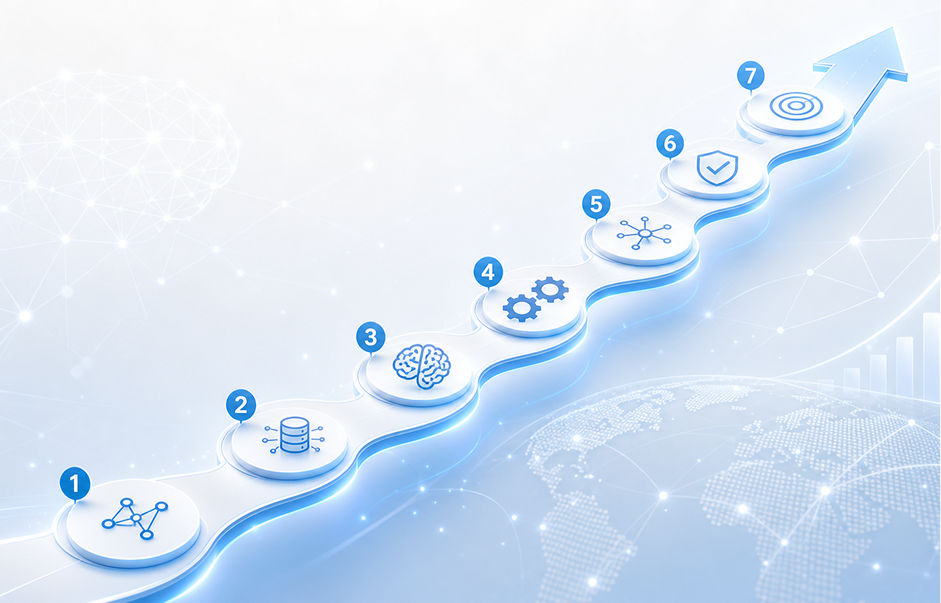
Having spent two decades at the intersection of academic research and applied AI, and having helped deliver 120+ AI projects across 20+ countries through Techtics.ai, I have seen the same pattern repeatedly. Organizations that succeed with AI do not start with technology. They start with a structured assessment of need, value, feasibility, and risk, and they execute through a staged, measurable implementation pipeline. This article lays out that roadmap.

Step 1: Begin with an Honest AI Need Assessment
Every successful AI journey begins with a deceptively simple question: What problem are we actually trying to solve?
Too many AI initiatives are born from FOMO rather than need. The board hears competitors are "doing AI," and a mandate descends without any connection to operational pain points. This is precisely the dynamic Gartner analysts describe when they note that most early agentic AI projects are "driven by hype and often misapplied."
A genuine need assessment examines your organization's value chain end to end and asks:
- Where do we lose the most time, money, or quality today?
- Which decisions are made slowly, inconsistently, or with incomplete information?
- Which processes are repetitive, rule-bound, and data-rich, the natural habitat of automation?
- Where are customers or employees experiencing friction that better intelligence could remove?
The output of this stage is not a technology wishlist. It is a prioritized map of business pains and opportunities, expressed in the language of operations and finance, not in the language of models and algorithms.
Step 2: Identify Potential Use Cases and Cast a Wide Net
With needs mapped, translate them into candidate AI use cases. At this stage, breadth matters more than precision. Industry frameworks such as Gartner's AI use-case prisms are instructive here: whether you operate in insurance, media, utilities, legal practice, B2B sales, digital commerce, smart cities, or automotive, there are typically 15 to 20 well-recognized use cases per industry, from churn prediction and fraud detection to demand forecasting, content personalization, predictive maintenance, lead scoring, and intelligent process automation.
Workshop these with the people who actually run the processes. In our discovery workshops at Techtics, frontline managers routinely surface automation candidates that never appear on the executive radar: the invoice that takes three departments to validate, the phone orders transcribed manually, the blueprints reviewed line by line. These "unglamorous" use cases are often the highest-ROI ones.
Step 3: Evaluate Every Use Case on Two Axes — Business Value and Feasibility
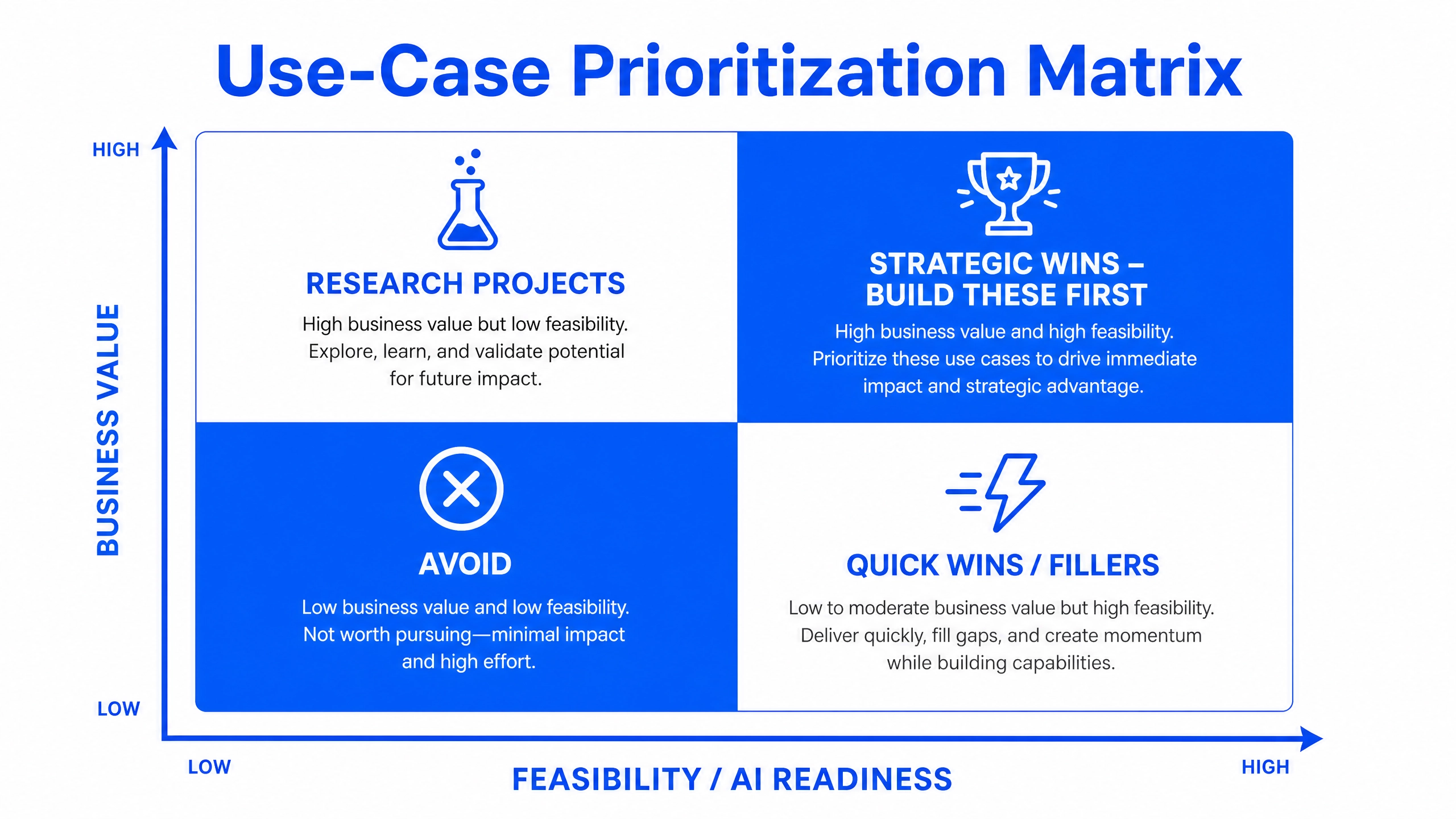
This is the heart of the methodology, and it is where most organizations cut corners. Every candidate use case must be plotted against two independent dimensions: the business value it can create and the feasibility of actually delivering it. A use case that scores high on value but low on feasibility is a research project, not a roadmap item. A use case that is highly feasible but low value is a distraction.

The Business Value Lens
Value addition from AI automation typically flows through four channels: positive financial impact (cost reduction and revenue growth), improved quality (of service, product, and operations), time reduction, and reduced human intervention. In practice, I encourage leadership teams to score each use case against a concrete checklist: process improvement (does it remove steps, handoffs, or rework?), service improvement, HR efficiency, cost reduction, error reduction, quality improvement, offering scale (can you serve 10x volume without 10x headcount?), and revenue increase.
Then perform a hard-nosed revenue-versus-cost analysis. Estimate the total cost of ownership (not just development, but deployment, recurring inference and licensing costs, and maintenance) against quantified annual value. If the payback period exceeds 18 to 24 months under conservative assumptions, deprioritize.
These projections are not fantasy when grounded in real benchmarks. From our own delivery portfolio: a retail computer-vision analytics deployment delivered a 10% increase in customer base, 12% improvement in conversion, and 10% reduction in human resource requirements; a food-and-beverage analytics solution cut food wastage by 10% while optimizing HR deployment by 20%; a power-plant anomaly detection system lifted plant productivity by 12%; and an insurance field-force automation improved productivity by 400%. Realistic, sector-specific reference points like these should anchor your value estimates.
The Feasibility / AI-Readiness Lens
Feasibility is where the 30% to 95% failure statistics are born. Gartner's research attributes most AI project failures to poor data quality and predicts that 60% of AI projects lacking AI-ready data will be abandoned through 2026. Feasibility assessment must therefore go far beyond "can the model be built?" It spans technical, organizational, and adoption readiness:
- Organizational readiness. Are the underlying processes well-defined and stable enough to automate? Is the process digitalized, or does it still live on paper and tribal knowledge? Does the data needed for AI exist, in usable quality and volume, with the rights to use it? Do the relevant stakeholders genuinely intend to change how they work?
- Management readiness. Is top leadership visibly committed, not just approving but sponsoring? Is there financial readiness to fund not only the build, but the run? McKinsey found that, among 25 organizational attributes tested, redesigning workflows and putting senior leaders in critical AI roles had the strongest correlation with realizing EBIT impact from AI. AI delegated to the IT department alone almost always stalls.
- Cost realism. Account for the full cost stack: development cost, deployment and running cost, recurring costs (API and LLM usage, compute, licensing), and maintenance cost. GenAI in particular carries recurring inference costs that can quietly dwarf the initial build, which is one of the principal reasons Gartner cites "escalating costs" as a top abandonment driver.
- Relevant departments' readiness and willingness. Are the stakeholders who own the process open to this change? Do they have, and will they share, the data? Are they willing to adopt the solution and adapt their ways of working around it? A technically perfect system that the operating team quietly works around delivers zero value. BCG's 10-20-70 principle captures this: AI success is roughly 10% algorithms, 20% data and technology, and 70% people, process, and cultural transformation.
- Occurrence frequency. How often is the use case executed? How much time does each execution take, and what does it cost? Automation economics compound with frequency: a process run 10,000 times a month justifies investment that a quarterly process never will. Frequency also determines whether automation scales the business, turning a capacity ceiling into a growth lever.
Step 4: Risk Analysis — The Dimension Everyone Skips
Before selection, every shortlisted use case must pass a structured risk review across at least three dimensions:
- Correctness risk. What happens when the AI is wrong? A product-recommendation error costs a click; an error in invoice validation, medical imaging, or legal document analysis costs real money and trust. Define acceptable error tolerances, human-in-the-loop checkpoints, and fallback procedures before you build. McKinsey's surveys consistently show inaccuracy is the most commonly experienced negative consequence of GenAI use.
- Dependency on external AI (LLMs). Building on third-party foundation models introduces dependencies on pricing changes, model deprecations, rate limits, behavior drift across versions, and vendor lock-in. A sound architecture abstracts the model layer, benchmarks alternatives, and, where volume justifies it, considers fine-tuned or self-hosted models to control recurring cost and continuity risk.
- Data privacy and security. Where does your data go when it enters an AI pipeline? Regulatory regimes (GDPR, HIPAA, sector-specific rules) and customer trust both demand clear answers. This consideration alone often dictates the deployment model (on-premises, private cloud, or hybrid), which in turn reshapes the cost equation.
Step 5: Select and Prioritize
With value, feasibility, and risk scored, selection becomes almost mechanical: choose use cases that sit in the high-value, high-feasibility, manageable-risk quadrant. Then prioritize within that set using three tie-breakers:
- Time-to-value. Early, visible wins build the organizational confidence that funds the harder, bigger wins later.
- Strategic leverage. Does this use case build data assets, infrastructure, or capabilities that make the next use cases cheaper?
- Sponsorship strength. Start where the business owner is most committed.
Resist the temptation to launch five initiatives at once. The organizations stuck in "pilot purgatory" are usually those running many shallow experiments rather than a few deep deployments.
Step 6: Implement Through a Staged Pipeline
For each selected use case, disciplined staging is what separates the 5% who realize value from the rest. The pipeline runs PoC, then MVP, then Pilot, then Scale, then Deployment and Maintenance, with a hard gate between every stage:
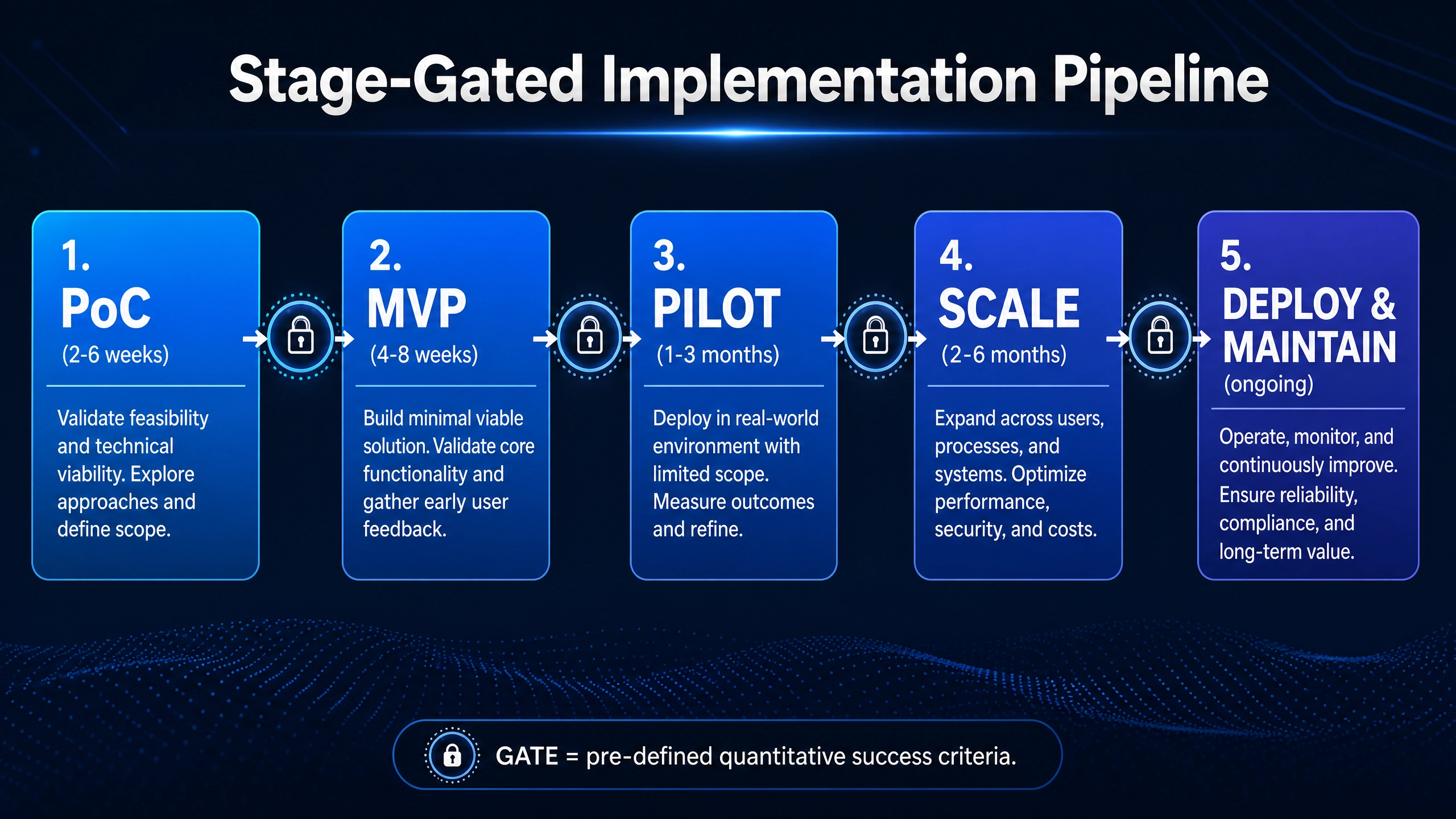
- Proof of Concept (2–6 weeks). Validate the core technical hypothesis on real (not curated) data. The deliverable is evidence, not a product. Define quantitative success criteria upfront, and be willing to kill the project here cheaply. A killed PoC is a success of the methodology, not a failure.
- MVP. Build the minimum end-to-end system a real user can use for a real task, integrated with at least one real upstream and downstream system. This is where integration realities surface.
- Pilot. Run in a live operational environment with a bounded scope: one region, one product line, one team. Measure business KPIs, not model metrics: cycle time, error rate, cost per transaction, user adoption. The pilot is a stress test of organizational readiness as much as of technology.
- Scale. Expand coverage with hardened infrastructure, monitoring, retraining pipelines, and support processes. This is where data drift, edge cases, and load break naive systems. Plan for it from MVP onward, not after.
- Deployment and Maintenance. AI systems are living systems. Models degrade, data distributions shift, business rules change, and LLM providers update their models. Budget ongoing MLOps, monitoring, and periodic revalidation as a permanent operating cost, not an afterthought.
Step 7: Close the Loop — Expected Value vs. Actual Value
The final discipline, and the rarest, is the review assessment: a formal comparison of the value you projected in Step 3 against the value actually realized in production. McKinsey notes that most organizations still lack robust KPIs for their AI initiatives, and that where rigorous tracking exists, value realization rises and risk incidents fall.
Did the 12% productivity lift materialize, or did it stop at 6%, and why? Was the recurring cost in line with the forecast? Did adoption hold after the novelty faded? This review does three things: it keeps everyone honest, it sharpens the assumptions for the next use case, and it converts AI from a faith-based investment into a managed portfolio.
The Very Important Concern: Choosing the Right Technology Partner
Everything above describes what to do. The most consequential decision, however, is often who you do it with, and it deserves direct treatment.
An impactful and sensible AI strategy is rarely developed in isolation. It is best built with a technology partner and consultant who brings relevant, cross-industry delivery experience: someone who has seen where feasibility assessments go wrong, which value estimates prove optimistic, and which architectural decisions come back to haunt you in year two.
Here is the uncomfortable truth about AI economics that inexperienced teams learn expensively: the build cost is only the entry ticket. The development cost, the recurring cost of running the automation, the deployment cost, the maintenance cost, and the selection of the appropriate deployment model (on-premises, cloud, or hybrid) collectively determine whether your AI initiative is an asset or a liability. A GenAI solution that delights in the demo can hemorrhage money in production if every transaction triggers expensive LLM calls that a smarter design would have avoided.
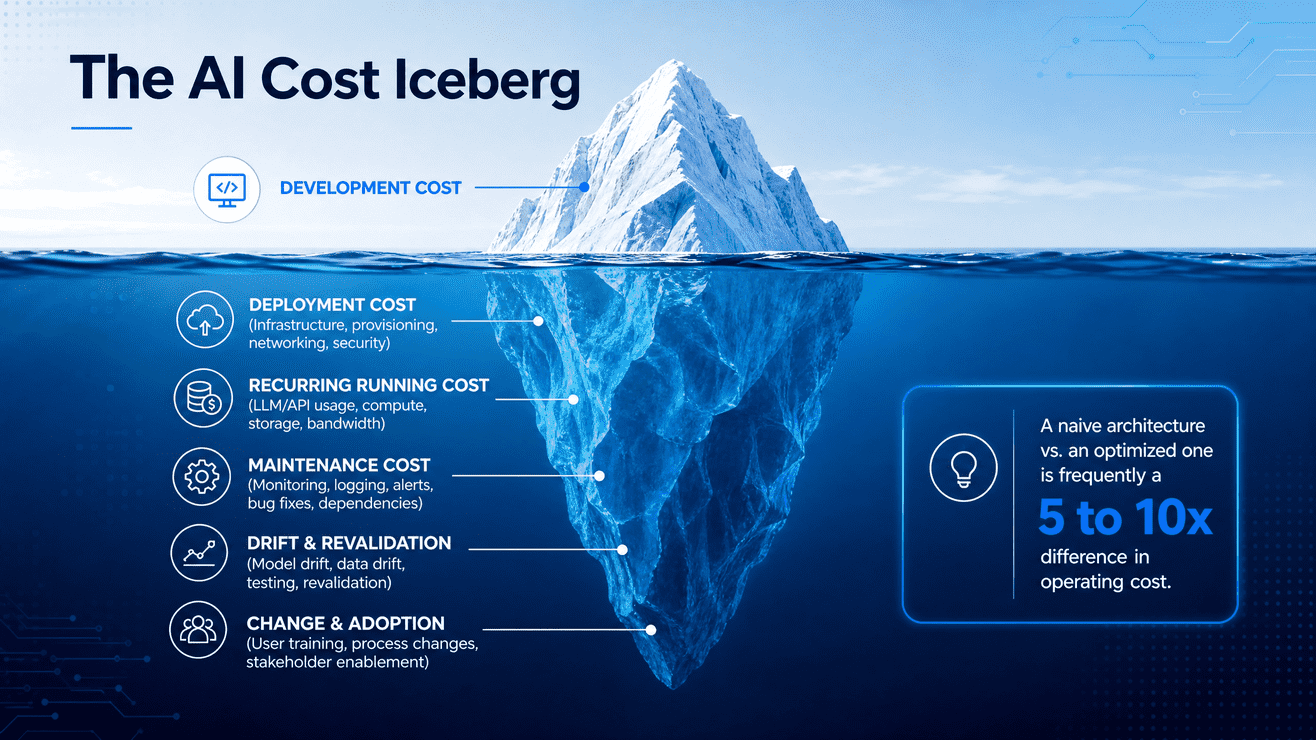
This is where seasoned teams distinguish themselves. They do not merely develop a solution; they develop a cost-effective solution, using smart algorithms, caching strategies, model right-sizing (using a small model where a large one is unnecessary), retrieval architectures, hybrid rule-based/ML designs, and other architectural improvisations that systematically minimize recurring cost. The difference between a naive architecture and an optimized one is frequently 5x to 10x in operating cost, which is the difference between a positive and negative ROI on the same use case.
When evaluating a partner, ask:
- Can they show delivered outcomes with numbers, not just demos?
- Do they have breadth across agentic AI, generative AI, computer vision, and data analytics, so they recommend the right tool rather than the only tool they know?
- Do they lead with discovery and feasibility assessment, or do they jump straight to a quote?
- Can they articulate your total cost of ownership across deployment options before writing a line of code?
- Will they structure delivery as PoC, MVP, Pilot, then Scale, with kill-switches and success criteria at each gate?
Where Techtics.ai Fits In
At Techtics.ai, this methodology is not theory; it is how we work. Founded in 2022 and now 80+ professionals strong, with 10 PhDs, 200+ research publications, and 120+ delivered projects across 20+ countries, we have built our practice around exactly the lifecycle described in this article: discovery workshops (1–2 weeks), proof of concept (2–6 weeks), development and deployment (2–6 months), and go-live support. In practical terms, your PoC can be in your hands within 3 to 4 weeks of our first conversation.
Our delivery spans agentic AI (multi-agent CRM and order automation, AI-driven invoice processing, voice ordering agents, B2B lead-generation automation), generative AI (content automation, AI-powered screening, financial agents, 3D modeling for e-commerce), computer vision (retail analytics, fleet management, aerial surveillance, insurance auto-scan), and data analytics (anomaly detection, forecasting, waste-reduction analytics), across retail, supply chain, education, insurance, food & beverage, cybersecurity, legal, media, and more.
More importantly, we engage as a strategic partner, not a vendor: we will tell you which of your use cases not to build, we will design for your recurring-cost reality and your deployment constraints, and we will measure ourselves against the actual-versus-expected value review, because that is the only metric that matters.
If you are ready to move from AI ambition to AI impact, let's start with a discovery workshop.

Zero-Trust Security Frameworks for AI-First Organizations
For three decades, enterprise security was built around a simple assumption: define a perimeter, secure it, and trust whatever sits inside it. That model made sense when "inside the network" meant employees on company devices, behind a firewall, accessing systems through known applications.
AI-first organizations have quietly broken that assumption. Autonomous agents now query databases, call APIs, trigger workflows, and make decisions without a human clicking anything. The "trusted insider" in today's enterprise might be a piece of software that was prompted into existence an hour ago. Perimeter security has no good answer for that — which is exactly why zero trust has moved from a security buzzword to an operational necessity.
Why Traditional Perimeter Security Fails AI-First Organizations
Perimeter-based security assumes a relatively static, predictable set of actors: known users, known devices, known applications, all operating inside a defined boundary. AI systems violate nearly every part of that assumption.
Agents act with their own credentials, not a human's. An AI agent calling internal APIs, querying a database, or triggering a downstream workflow isn't a person logging in from a recognized laptop — it's a service identity that can be spun up, modified, or duplicated in seconds.
The attack surface is conversational, not just structural. Prompt injection attacks don't exploit a network vulnerability; they exploit the model's interpretation of input text. A malicious instruction embedded in a document, email, or web page can manipulate an agent into taking unauthorized actions, and a firewall has no visibility into that kind of attack at all.
Excessive agency creates new blast radii. When an AI agent is granted broad permissions to "get the job done" — access to multiple systems, the ability to execute code, the ability to send communications — a single compromised or manipulated agent can cause damage across every system it touches, not just the one it was originally deployed for.
Workloads move and scale dynamically. Containers, serverless functions, and orchestrated AI pipelines spin up and tear down constantly, which makes a fixed network perimeter nearly impossible to define in the first place.
None of this means perimeter security is worthless — but it means it's no longer sufficient on its own. Organizations deploying AI agents at scale need a model that doesn't assume safety based on location inside a network boundary.
What Zero Trust Actually Means
Zero trust is often summarized as "never trust, always verify," but the more useful framing for AI-first organizations is this: assume any identity, device, workload, or data request could be compromised, and require continuous verification before granting access — regardless of where the request originates.
This is a meaningful shift from perimeter thinking. Instead of asking "is this inside our network," zero trust asks "is this specific request, from this specific identity, for this specific resource, legitimate right now." That question gets asked every time, not once at login.
The Four Pillars of Zero Trust for AI Systems
A practical zero-trust architecture for AI-first organizations rests on four areas of continuous verification.
Identity
Every human user, service account, and AI agent needs a distinct, verifiable identity — not shared credentials, not generic API keys reused across systems. Agent identities should be issued, rotated, and revoked with the same discipline applied to human accounts, and every action an agent takes should be traceable back to that specific identity.
Device
The infrastructure an AI workload runs on — the container, the virtual machine, the edge device — needs to be verified as a known, compliant environment before it's trusted with sensitive operations. This matters more in AI systems than traditional ones because inference often happens across distributed, ephemeral compute resources rather than a fixed set of company-owned machines.
Workload
Each service, model, and pipeline component should be treated as its own trust boundary, with explicit rules governing what it can call, what data it can access, and what actions it can trigger. Microsegmentation — isolating workloads from each other rather than allowing broad internal network access — limits how far a compromised agent or model can reach.
Data
Data needs classification, encryption, and access policies that travel with it, not protections that depend on where the data happens to sit. When an AI agent retrieves data to answer a query or take an action, that retrieval should be checked against the same access policy a human user would face — not granted automatically because the request came from "inside" the system.
The Unique Attack Surface of Autonomous AI Agents
AI-first organizations face attack vectors that didn't meaningfully exist in pre-AI enterprise environments:
- Prompt injection. Malicious instructions hidden in documents, emails, or retrieved web content can hijack an agent's behavior, redirecting it to leak data or perform unauthorized actions.
- Tool and function-calling abuse. Agents with access to tools — sending emails, executing code, modifying records — can be manipulated into misusing those tools in ways a static application never could be.
- Excessive agency. Granting an agent broad, standing permissions "just in case" turns a narrow task into a wide-open liability if that agent is ever compromised or manipulated.
- Model and data poisoning. Attackers targeting training data or fine-tuning pipelines can introduce subtle behavioral changes that are difficult to detect through conventional security monitoring.
- Insecure agent-to-agent communication. As multi-agent systems become more common, the channels agents use to coordinate with each other become a new, often under-monitored attack surface.
These risks share a common thread: they exploit trust granted by default rather than verified continuously, which is precisely the gap zero trust is designed to close.
Implementing Zero Trust for AI Agents: Practical Steps
Issue scoped, short-lived credentials for every agent. Replace long-lived API keys with credentials that expire quickly and grant access only to the specific resources a given task requires — not standing access to entire systems.
Apply least-privilege access by default. An agent built to summarize support tickets shouldn't also have write access to the billing database. Default to the narrowest permission set that allows the task to function, and expand only with explicit justification.
Microsegment workloads. Isolate AI services from each other and from broader internal networks so that a compromised component can't move laterally to systems it was never meant to touch.
Monitor continuously, not just at access time. Behavioral anomaly detection — flagging when an agent suddenly accesses unusual data, calls unfamiliar tools, or deviates from expected patterns — catches manipulation that a one-time login check would miss entirely.
Classify and encrypt data at the source. Data should carry its access policy with it, so that any agent or service retrieving it is automatically subject to the same rules regardless of how it was queried.
Require human-in-the-loop checkpoints for high-risk actions. Irreversible or high-impact actions — financial transactions, external communications, code deployment — should route through human approval rather than full autonomous execution, at least until an agent's reliability has been extensively validated.
Validate and sanitize inputs to agents. Treat any external content an agent processes — documents, emails, scraped web pages — as potentially adversarial, and build filtering layers that reduce the risk of embedded prompt injection reaching the model unchecked.
Common Mistakes Organizations Make
Many AI-first organizations adopt zero-trust language without changing underlying architecture. A few patterns show up repeatedly:
- Treating zero trust as a product purchase rather than an architectural shift. A single identity tool doesn't deliver zero trust if workloads still communicate over flat, unsegmented networks.
- Granting agents human-equivalent access "to be safe." This inverts least-privilege thinking and creates exactly the broad blast radius zero trust is meant to prevent.
- Verifying identity once at deployment and never again. Continuous verification means re-checking trust at each request, not establishing it once when an agent is first provisioned.
- Ignoring agent-to-agent traffic. As multi-agent architectures grow, the assumption that "internal" agent communication is automatically safe recreates the same blind spot perimeter security had for human users.
Building a Zero-Trust Roadmap for AI Adoption
Organizations don't need to implement every control simultaneously. A practical rollout typically starts with identity — issuing distinct, scoped credentials for every agent and service — followed by microsegmentation of the highest-risk workloads, then continuous monitoring layered on top. Data classification and encryption policies should be established early, since retrofitting them after agents are already in production is significantly harder than building them in from the start.
The organizations managing AI risk well aren't the ones avoiding autonomous agents — they're the ones that have rebuilt their security architecture around the assumption that any identity, device, workload, or data request might be compromised, and verify accordingly, every time.
Talk to Our Team About Securing Your AI Systems
If your organization is deploying autonomous agents faster than your security architecture has evolved to handle them, that gap is worth closing before it becomes an incident. Talk to our team about building a zero-trust framework designed for how AI systems actually operate.

First Call to POC: How We Compress 6-Month to 5 Weeks
If you've ever sat through an enterprise AI pitch, you've heard the timeline: six months to a proof of concept. Sometimes nine. The vendor walks you through a Gantt chart full of "discovery phases" and "alignment workshops," and by month four you're still debating data access policies instead of looking at a working model.
That timeline isn't a reflection of how hard AI is to build. It's a reflection of how badly most teams manage the process of building it.
At Techtics, we take clients from first call to a validated, working proof of concept in five weeks. Not five weeks of slide decks — five weeks that end with a functioning system your team can actually test against real data and real workflows. Here's how that compression happens, and why it isn't about cutting corners.
Why Most AI Timelines Run Six Months (or Longer)
Six-month AI engagements rarely fail because the underlying model is hard to train. They fail because of structural drag built into how enterprise teams typically approach AI projects.
Procurement and vendor evaluation eat the first six to eight weeks.
Most organizations run a formal RFP process before a single line of code gets written, comparing five vendors against requirements that are still being defined.
Requirements gathering becomes a project of its own.
Stakeholders from product, engineering, compliance, and operations all need to weigh in, and reconciling their priorities can stretch into months if there's no structured way to capture and validate use cases quickly.
Data access and integration get treated as an afterthought.
Teams often don't audit their data sources, APIs, and system access until after the build has started, which means the engineering team discovers blockers mid-sprint instead of in week one.
Scope keeps expanding.
Without a fixed, validated use case, "let's also add this feature" creeps in continuously, and a focused POC slowly turns into a half-built production system that never quite ships.
None of these are technology problems. They're sequencing and discipline problems — and they're fixable.
The Real Bottleneck Isn't Technology, It's Process
Modern AI tooling — pretrained models, vector databases, orchestration frameworks, cloud-native infrastructure — has compressed the technical build time for a focused POC down to days, not months. A well-scoped predictive model, a retrieval-augmented chatbot, or an automation workflow can be prototyped in a sprint by an experienced team.
What actually consumes time is everything around the build: getting the right people in a room, validating that the use case is real before writing code, securing data access, and aligning on what "done" looks like. Compress those steps and the technical build naturally fits inside the remaining runway.
This is the core insight behind our 5-week framework: treat process compression, not engineering speed, as the primary lever.
The 5-Week Framework: From First Call to Validated POC
Week 1 — Discovery and Use Case Validation
The first call isn't a sales conversation; it's a working session. We map the business problem, identify the specific decision or workflow the AI system needs to improve, and validate that the use case is solvable with available data before committing engineering time. By the end of week one, there's a written scope document with success metrics both sides have signed off on.
Week 2 — Data Audit and Architecture Sprint
This is where most enterprise timelines silently lose months, so we front-load it. Our team audits data sources, API access, security requirements, and existing infrastructure in parallel with architecture design. We identify blockers now — missing data, access bottlenecks, compliance constraints — while there's still time to route around them without derailing the build.
Week 3 — Build Sprint
With scope and data access confirmed, the engineering team builds the core system: the model, the automation pipeline, the agent workflow, or whichever architecture fits the validated use case. Because scope was locked in week one, the team isn't building against a moving target.
Week 4 — Integration and Testing
The POC gets connected to a real (or representative) data environment and tested against the success metrics defined in week one. This is also when we run edge cases and stress-test the system against the messy, inconsistent data that real production environments actually contain, rather than the clean sample sets most demos rely on.
Week 5 — Validation and Stakeholder Sign-off
The final week is for the client's team to actually use the system, not watch a demo of it. Stakeholders test it against real scenarios, we capture feedback, and we document a clear path from POC to production scale-up. By the end of week five, you have a working system and a data-backed decision on whether to move forward.
What Makes Compression Possible (Without Cutting Corners)
A 5-week timeline only works because of decisions made well before the engagement starts:
- Reusable component libraries. Common building blocks — authentication layers, data connectors, model evaluation pipelines — don't get rebuilt from scratch for every client, which removes weeks of redundant engineering.
- Parallel workstreams instead of sequential handoffs. Data audits, architecture design, and early prototyping happen simultaneously rather than waiting on each other in a linear chain.
- Fixed-scope POC agreements. Locking the use case in week one prevents the scope creep that quietly turns a five-week sprint into a five-month slog.
- Embedded subject matter access. Having a PhD-level research team and domain specialists involved from day one means fewer "let's circle back next week" delays caused by needing outside expert input.
- Pre-vetted infrastructure templates. Cloud architecture and CI/CD patterns that have already been proven across 150+ prior projects don't need to be re-validated from zero each time.
This is compression through preparation, not through skipping validation steps. The POC that comes out the other end is something your team can stress-test, not a fragile demo built to impress in a single meeting.
What This Means for Enterprise Buyers
If you're evaluating AI vendors, the length of a proposed timeline tells you more about their process maturity than their technical capability. A team that needs six months to reach a POC is often telling you they haven't solved the coordination problem — not that the AI problem itself is six months deep.
A faster, well-structured timeline also changes the risk profile of the decision. Instead of committing budget and internal resources for half a year before seeing results, a 5-week POC gives you a concrete, testable artifact to evaluate before any larger commitment. That shifts AI adoption from a leap of faith into a series of small, validated bets.
Common Pitfalls That Stretch Timelines Back to Six Months
Even with a compressed framework available, a few mistakes can pull a project back toward the slow end:
- Skipping the data audit. Teams that jump straight to building without confirming data access almost always hit a wall mid-sprint.
- Letting stakeholders weigh in after the build starts. Validation needs to happen in week one, not week four, or scope will shift under the team's feet.
- Treating the POC like a finished product. A POC exists to validate an approach with real users and real data — not to ship every feature a production system would eventually need.
- Choosing a use case that's too broad. "Improve customer service with AI" isn't a scoped use case. "Reduce average response time on tier-one billing tickets using an AI triage agent" is.
Is Five Weeks Right for Every Use Case?
Not every AI initiative fits neatly into a five-week box — a multi-system enterprise rollout touching dozens of legacy integrations will need a longer runway. But for the most common entry point into enterprise AI — a focused proof of concept validating one clear use case — five weeks is achievable for the vast majority of organizations, provided the discovery and data audit steps aren't skipped.
The goal isn't speed for its own sake. It's removing the unnecessary friction that turns a solvable problem into a half-year commitment, so your organization can make a confident, evidence-based decision about scaling AI faster.
Frequently Asked Questions
How is a 5-week POC different from a typical MVP? A POC validates whether an approach works at all — does the model perform well enough on real data, does the workflow actually save time, is the use case technically feasible. An MVP assumes the approach is already validated and focuses on shipping a usable product to early customers. The 5-week framework is built for the validation stage, which is exactly where most AI initiatives stall.
What happens after the POC if we want to move to production? The week 5 deliverable includes a documented scale-up path: infrastructure requirements, security and compliance considerations, integration points with existing systems, and an estimated timeline for production deployment. Clients use this to make an informed go/no-go decision with their own stakeholders before committing further budget.
What if our data isn't ready? This is exactly why the data audit happens in week two rather than being assumed away. If data quality or access issues surface, we flag them immediately and adjust scope — sometimes that means narrowing the use case to data that is available now, with a roadmap for expanding once additional data sources are cleaned up or connected.
Does a faster timeline mean a less rigorous build? No. Rigor comes from validating the use case correctly and testing against real conditions in week four, not from how many calendar weeks the engagement runs. The compression comes from removing redundant process overhead, not from skipping testing or validation steps.
Ready to See Your Use Case in Five Weeks?
If your team has been quoted a six-month AI timeline, there's a good chance the bottleneck isn't the technology — it's the process around it. Talk to our team and find out what a validated proof of concept could look like for your organization in five weeks, not six months.
Ready to Go Beyond the Article?

Technology is
in our DNA

.png)
